

Lakes are an essential part of India’s geographical and ecological landscape. They serve as sources of drinking water, irrigation, hydroelectric power, Navigation, Livelihood and biodiversity conservation. India has a variety of lakes, ranging from freshwater to saltwater, natural to artificial, and glacial to crater lakes. According to the first-ever national waterbody census, Tamil Nadu has the highest number of lakes, with 13,629 identified.
Importance of Lakes in India:
Lakes in India are not only a source of natural beauty but also offer numerous economic and ecological benefits. Some of the key roles of lakes include:
- Lakes provide drinking water and irrigation.
- They support aquatic ecosystems and migratory birds.
- Many lakes attract tourists, boosting local economies.
- Lakes act as reservoirs, regulating water flow.
- Fishing and related activities offer employment.
Categories of Lakes in India:
Lakes in India are classified based on their water composition, formation, and location. The following are the main types of lakes found in the country:
Freshwater Lakes: Contain fresh water and are primarily used for drinking and irrigation (Eg: Wular, Kolleru)
Natural Lakes: Formed naturally due to tectonic movements, glacial activities, or river meandering.
Oxbow Lakes: Formed when a river changes its course and leaves behind a lake in the shape of a crescent (U Shaped water body) (Eg: Kanwar)
Saltwater Lakes: Contain saline or brackish water (Eg: Sambhar,Chilka)
Crater Lakes: Formed due to volcanic eruptions or meteorite impacts (Eg: Lonar)
Artificial Lakes: Created by human activities such as dam construction (Eg: Gobind Ballabh Pant Sagar)
Tectonic Lakes: Forms due to faults in earth crust (Eg: Wular, Loktak)
Fluvial Lakes: Formed by rivers through erosional and depositional activities (Eg: Kanwar, Suraha Tal, Chandubi)
Glacial Lakes: Melting ice and forms water in Mountain region(Himalayas) (Eg: Tso Moriri, Pangong Tso)
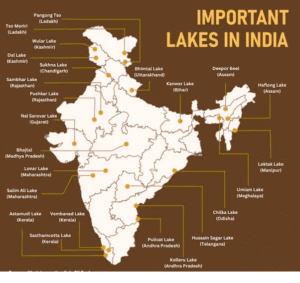
State-Wise List of Important Lakes in India:
| State/UT | Lakes |
| Andhra Pradesh | Pulicat Lake, Kolleru Lake |
| Assam | Haflong Lake, Chandubi Lake, Deepor Beel |
| Bihar | Kanwar Lake |
| Gujarat | Hamirsar Lake, Kankaria Lake, Sardar Sarovar |
| Haryana | Badkal Lake, Brahma Sarovar |
| Himachal Pradesh | Chandra Taal, Maharana Pratap Sagar |
| Jammu & Kashmir | Dal Lake, Wular Lake, Sheshnag Lake |
| Karnataka | Agara Lake, Ulsoor Lake |
| Kerala | Vembanad Lake (Punnamada Lake), Sasthamkotta, Kuttanad Lake, Ashtamudi Lake |
| Ladakh | Pangong, Tso Moriri |
| Madhya Pradesh | Bhojtal, Indira Sagar |
| Maharashtra | Shivsagar |
| Manipur | Loktak Lake |
| Meghalaya | Umiam Lake |
| Mizoram | Tam Dil |
| Odisha | Chilka Lake |
| Punjab | Harike, Kanjli |
| Rajasthan | Sambhar Lake,Pichola,Fateh Sagar,Jaisamand,Udai Sagar, Pushkar |
| Sikkim | Tsomgo Lake |
| Tamil Nadu | Chembarambakkam, Kaliveli |
| Telangana | Hussain Sagar |
| Uttar Pradesh | Govind Bhallabh Pant Sagar, Belasagar, Suraha Tal |
| Uttarakhand | Bhimtal, Nainital, Roopkund Lake, Satopanth Tal, Dodital |
Key Facts About Important Lakes in India
- The Wular Lake in Jammu and Kashmir is the largest freshwater lake in India.It was formed by tectonic activity and is fed by the Jhelum River. Wular Lake is a significant source of fish and supports a vibrant ecosystem. It also helps regulate the water flow of the Jhelum River, preventing floods.
- The longest lake in India is Vembanad Lake, located in Kerala. Covering an area of 2300 sq. km, it stretches across multiple districts and supports fishing, agriculture, and tourism. The lake is known by different names in various regions: Vembanad Lake in Kottayam, Punnamada Lake in Alappuzha, Kochi Lake in Kochi
- Smallest lake in India :Sursagar Lake (Gujarat)
- Deepest lake in India: Loktak Lake (Manipur)
- Largest freshwater lake in South India: Kolleru Lake(Andhra Pradesh) Recognized as a Ramsar Wetland Site (2002)
- City of Lakes :Udaipur (Rajasthan)
- Largest in land salt water lake in India: Sambhar Lake (Rajasthan)
- Highest lake in India: Tso Lhamo/Cholamu Lake (Sikkim)
- Lake City of India: Bhopal
- Notable artificial lake in India: Hussain Sagar Lake (Telangana)
- Most important lake for irrigation: Govind Sagar Dam (Himachal Pradesh)
- Largest Man made Lake: Gobind Ballabh Pant Sagar(UP)
- Most important lake for hydroelectric power generation: Pong Dam (Himachal Pradesh)
- Most important lake for recreation/tourism: Dal Lake (Jammu and Kashmir)
- Sambhar Lake in Rajasthan is The largest inland saltwater lake in India
- Chilika Lake in Odisha is The largest brackish water (Brackish water is a type of water that is saltier than freshwater but less salty than seawater. It’s a mix of freshwater and saltwater, often found in estuaries, where rivers meet the ocean) lake in India and it is the First Indian wetland to be declared a Ramsar Site (1981)
- Pulicat Lake in Andhra Pradesh is the Second-largest brackish water lake in India
- Lonar Lake is a notified National Geo-heritage Monument, saline, soda lake, located at Lonar in Buldhana district, Maharashtra formed by a meteor impact
- Kanwar Lake – Bihar (Asia’s largest freshwater oxbow lake)
- Tso Moriri in Ladakh is the Largest high-altitude lake in India
- The Caspian Sea is recognized as the Largest salt Lake in the world
- Longest lake in the world: Lake Baikal (Russia)
- Lake Superior and Lake Baikal are both large freshwater lakes, but they differ significantly in size and other characteristics. Lake Superior is the largest by surface area, while Lake Baikal is the largest by volume. Lake Baikal is also the world’s deepest lake
For Indian Geography Books: CLICK HERE
Please visit for more material: www.competitiveexamsmaterial.com